Model Diversity Is Not Fit Prediction
Showing a broader range of people can support a visual story. Predicting how a particular size fits requires a different kind of evidence.
Illustrative adults with different body shapes
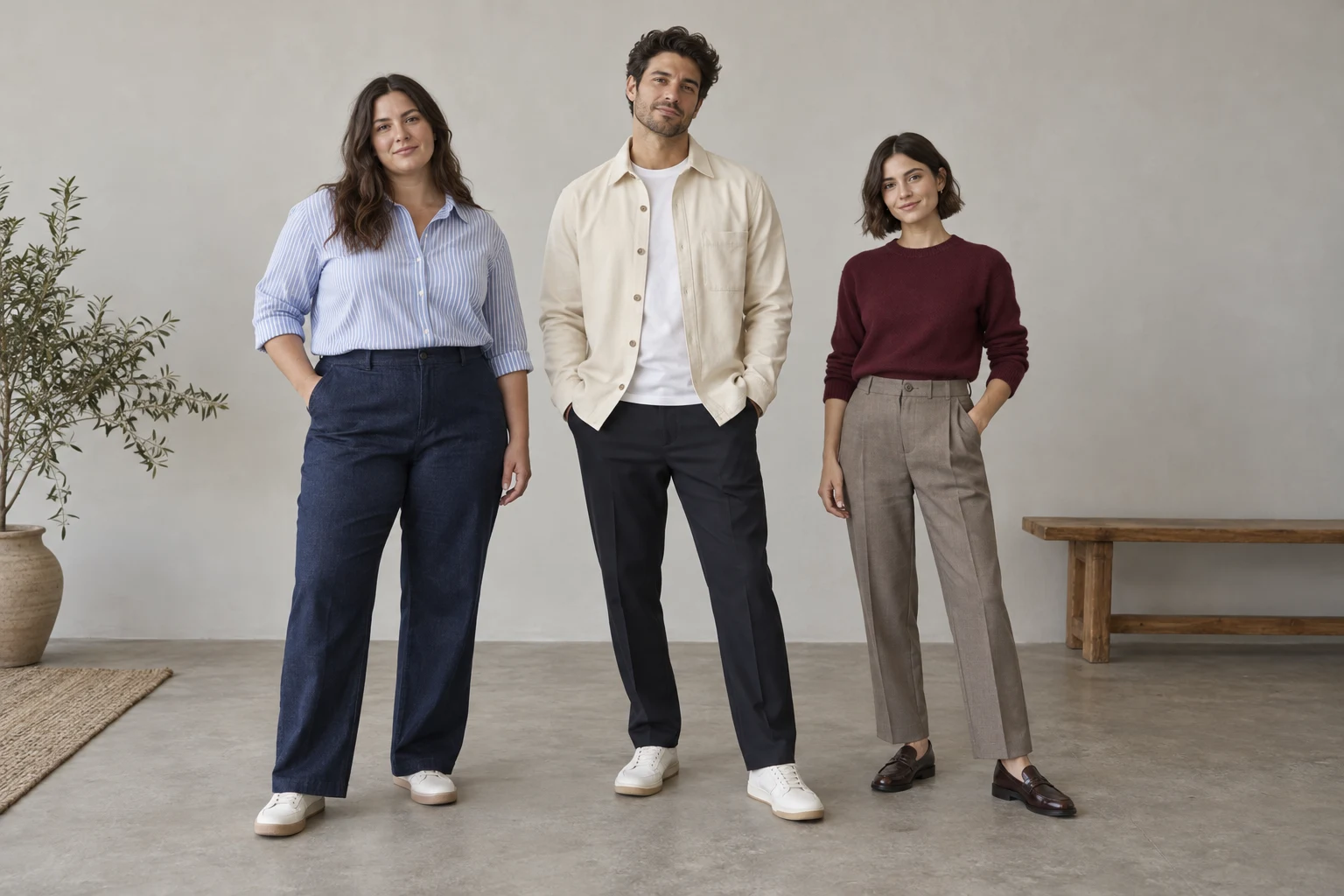
A size-inclusive image brief asks who is represented and how the collection is presented. A fit-prediction brief asks how a particular garment size will behave on a particular body. These are different jobs. A convincing generated person should not be used as a substitute for measurements, appropriate size information or real wear evidence.
A Reddit discussion in a plus-size community criticizes AI imagery with exaggerated, unrealistic proportions. The comments are not a survey of all shoppers, but they reveal a question worth taking seriously: does the representation feel connected to real people, or does it replace one narrow ideal with another?
Separate Representation from Measurement
- Representation
- Who appears in the image
- Garment identity
- Which item is being shown
- Fit evidence
- What measurements and wear testing establish
- Communication
- What the viewer can reasonably infer
In a creative brief, describe the intended casting with care and avoid reducing a person to a single body label. Consider height, proportions, age presentation and styling needs where relevant. The aim is a believable person wearing an identifiable garment, not a cartoon assembled from stereotyped features.
Fit-aware virtual try-on is an active research problem. The FIT preprint specifically discusses the need for garment and body size information. That helps explain the distinction: a visual image workflow that does not establish those inputs should not quietly acquire a sizing claim merely because the output looks realistic.
Protect the Garment Across Wearers
Person
Person
Choose believable proportions and a readable pose without exaggerated body stereotypes.
Product
Product
Preserve the intended garment, variant and construction in every visual direction.
Claim
Claim
Separate an editorial representation from verified measurement or fit information.
Keep the original product references visible during review. A different body context may change folds and visible proportions, but it should not authorize a different neckline, missing closure or invented panel. Record the exact garment variant and the wearing arrangement intended by the brand.
When a size range has actual construction or grading differences, use the relevant product sources. Do not assume that expanding a generated silhouette accurately represents another manufactured size. A shared style name does not prove that every size has identical proportions, detailing or placement of features.
Give the Image Honest Context
- Specify
- Define casting without stereotypes
- Source
- Keep the real garment references
- Review
- Check body and garment together
- Explain
- Keep fit information separate
Research on detailed virtual try-on explicitly treats preservation of clothing and person details as a technical challenge. That does not establish the performance of any current application in your workflow. Use the research to frame the review task, then evaluate your actual garment references and intended output.
Describe generated editorial imagery accurately where the context requires it, and keep factual sizing information accessible alongside it. A visible body does not tell a customer the garment’s measurements, stretch recovery or pressure at a seam. Avoid wording that invites those inferences unless you have suitable evidence to support them.
Review Body and Garment Together
A range of visual representation
A closer garment-context view
An inclusive casting brief is not complete when the person simply looks different. Check hands, limb continuity, contact with the environment and whether the garment remains readable. Pay particular attention to fabric transitions at the waist, bust, shoulders and arms, where an apparently polished result may quietly redraw the item.
Also look at the series. Are some people shown only in obscured poses while others receive clear product views? Are styling and camera distance comparable enough to make the representation meaningful? These are editorial choices. Document them rather than describing a generated collection as proof that the product fits everyone.
Prepare a Clearer Model Brief
Cast
Choose a believable direction that reflects the intended audience.
Reference
Use the appropriate garment sources and variant.
Direct
Keep a clear pose and visible product-defining areas.
Review
Check representation and product identity without claiming fit prediction.
Use Studiola to bring the garment and chosen model references into one creative context, with a pose that leaves important product areas visible. Make the image’s intended job explicit: an inclusive campaign direction, a coordinated collection story or a product-supporting lifestyle frame. Do not label the task a fitting service when it is visual production.
Keep real size and product information in the commerce workflow that supplies it. The visual team should know where that evidence lives, but should not invent it from an attractive result. Reusing a casting direction can simplify creative setup across a collection while every garment and generated person still receives individual review.
Set Clear Representation Boundaries
Believability
The person is represented without distorted or stereotyped proportions.
Identity
The garment remains the intended product and variant.
Context
The caption and placement do not imply unsupported fit certainty.
Evidence
Actual measurements and wear information remain separately available.
A useful handoff states the image’s role, the garment reference and the intended casting direction. Keep the approved image linked to the relevant variant and record any limits that matter to its use. This gives the publishing team a concrete basis for deciding where the image belongs and which factual information must accompany it.
The goal is not to make every marketing photograph carry a technical explanation. It is to avoid letting an editorial image make a stronger promise than the workflow supports. Respectful representation and accurate product information can coexist when the team keeps those responsibilities clear from the beginning.
Sources, method & questions
Published · By Studiola Editorial Team
Frequently asked questions
Can an AI model image recommend a clothing size?
An ordinary generated fashion image does not establish that capability. A size recommendation needs appropriate body, garment and validation inputs.
Can a brand include different body shapes in creative planning?
Yes. Define a thoughtful casting direction and review believable representation alongside product identity.
Are the people shown here fit-test participants?
No. They are AI-created editorial illustrations and do not demonstrate a physical garment fitting or application benchmark.
How this guide was researched
Researched from the linked primary sources on October 23, 2026. Community posts identify questions, not representative findings. Recommendations are editorial workflows; images are AI illustrations and diagrams, not tested Studiola outputs.
Sources & further reading
- 01FIT: A Large-Scale Dataset for Fit-Aware Virtual Try-On (preprint)
Research paper · arXiv · Primary source · Checked
- 02Towards Detailed Characteristic-Preserving Virtual Try-On
Google Research · Primary source · Checked
- 03Concerns about AI-generated plus-size representation
Reddit · r/PlusSize · Community question · Checked
Plan the casting without changing the product promise
Build a reference-led image direction with a readable pose and an explicit representation brief.